HPE
Rebuilding the engine while the house stayed occupied.
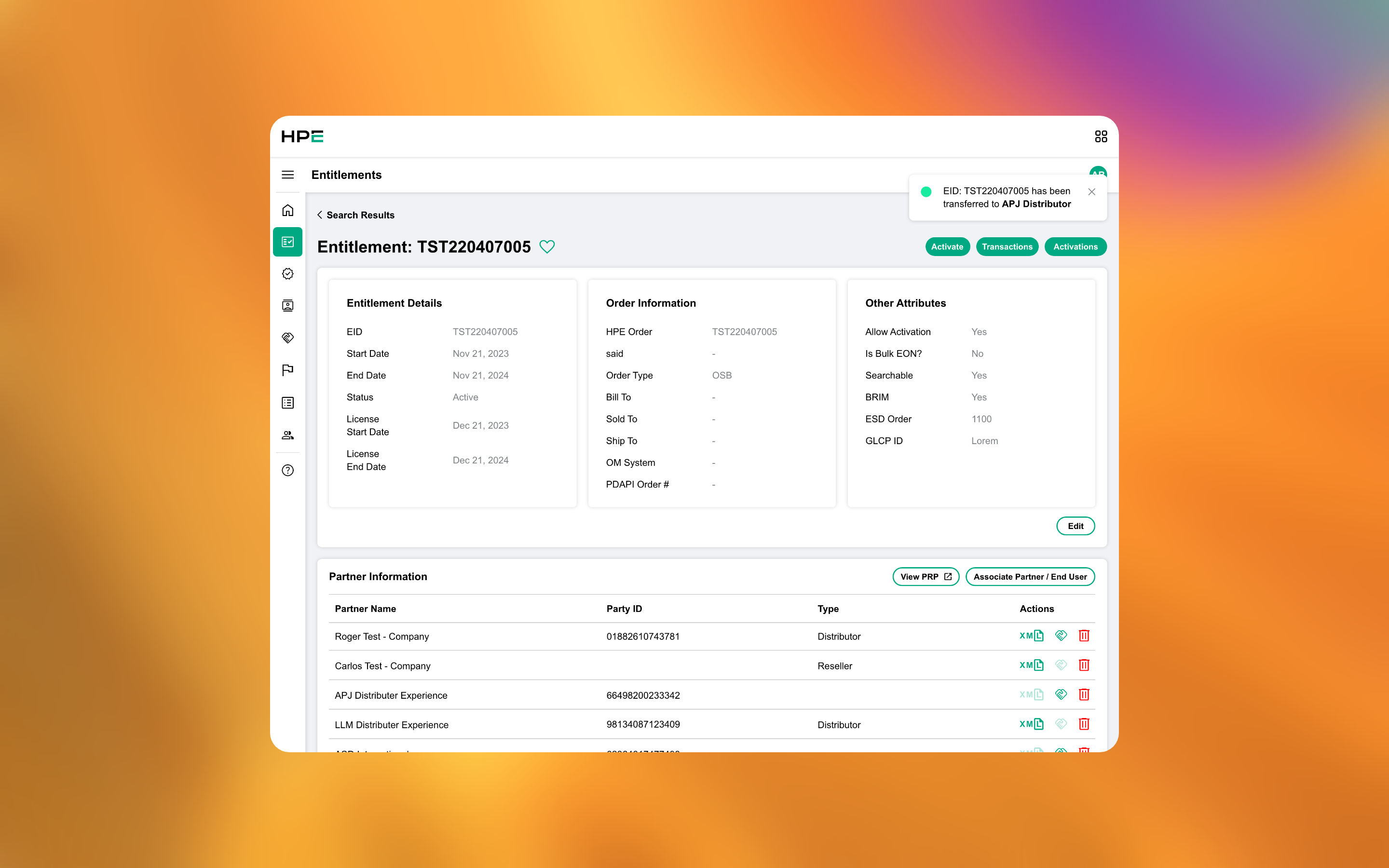
Replacing HPE's third-party entitlement management system with a custom-built platform — new UX/UI, new APIs, delivered without disrupting the customers actively depending on it.
ROLE
UX & UI Designer (UI + majority UX)
CLIENT
HPE (via Stellar)
TEAM
Stellar Agency
BACKGROUND
Replacing what nobody sees.
MSC and ESSM — HPE's customer-facing software portals — had always run on someone else's engine. Underneath both sat Thales' Sentinel Entitlement Management System, a third-party platform handling the actual work of license lifecycle management: activating software, tracking entitlements, managing transfers between partners and customers. MSC and ESSM were the storefronts. Sentinel was the warehouse nobody saw.
By 2022, HPE wanted to own the warehouse. Project Bumblebee replaced Sentinel entirely with a custom, HPE-owned platform — new UX/UI, new APIs, full control over the systems both products depended on. Not a redesign of a customer-facing screen: a ground-up rebuild of the infrastructure two live products relied on. Stellar took the full engagement — strategy, UX, visual design, front-end and back-end — and I came in as the UX/UI designer.
THE CHALLENGE
Real assets, real stakes, zero room for silent failure.
Entitlement management doesn't feel like a design problem until you sit with what it governs. Every entitlement represents software a customer paid for — a license, a subscription, activation rights tied to real contracts and real money. Bumblebee let HPE's internal teams and channel partners search entitlements, activate licenses, and — the highest-stakes actions in the system — split an entitlement across multiple partners or transfer it to a different owner entirely.
Get a split or transfer wrong and the consequences aren't cosmetic. A customer loses access to software they're entitled to. A partner ends up over-allocated on licenses they don't have. In a system moving real contractual rights between real companies, a forgiving interface isn't just bad UX — it's a liability.
The second challenge was less obvious: this platform had to serve two separate downstream products, each with its own established users and workflows, without either one absorbing chaos from replacing the engine underneath them.
THE WORK
Guardrails, not friction.
Bumblebee's surface area was large — Entitlements, Activations, End Customers, Channel Partners, Reports, Catalog, Access — but the sharpest design problem lived in two flows: Split and Transfer.
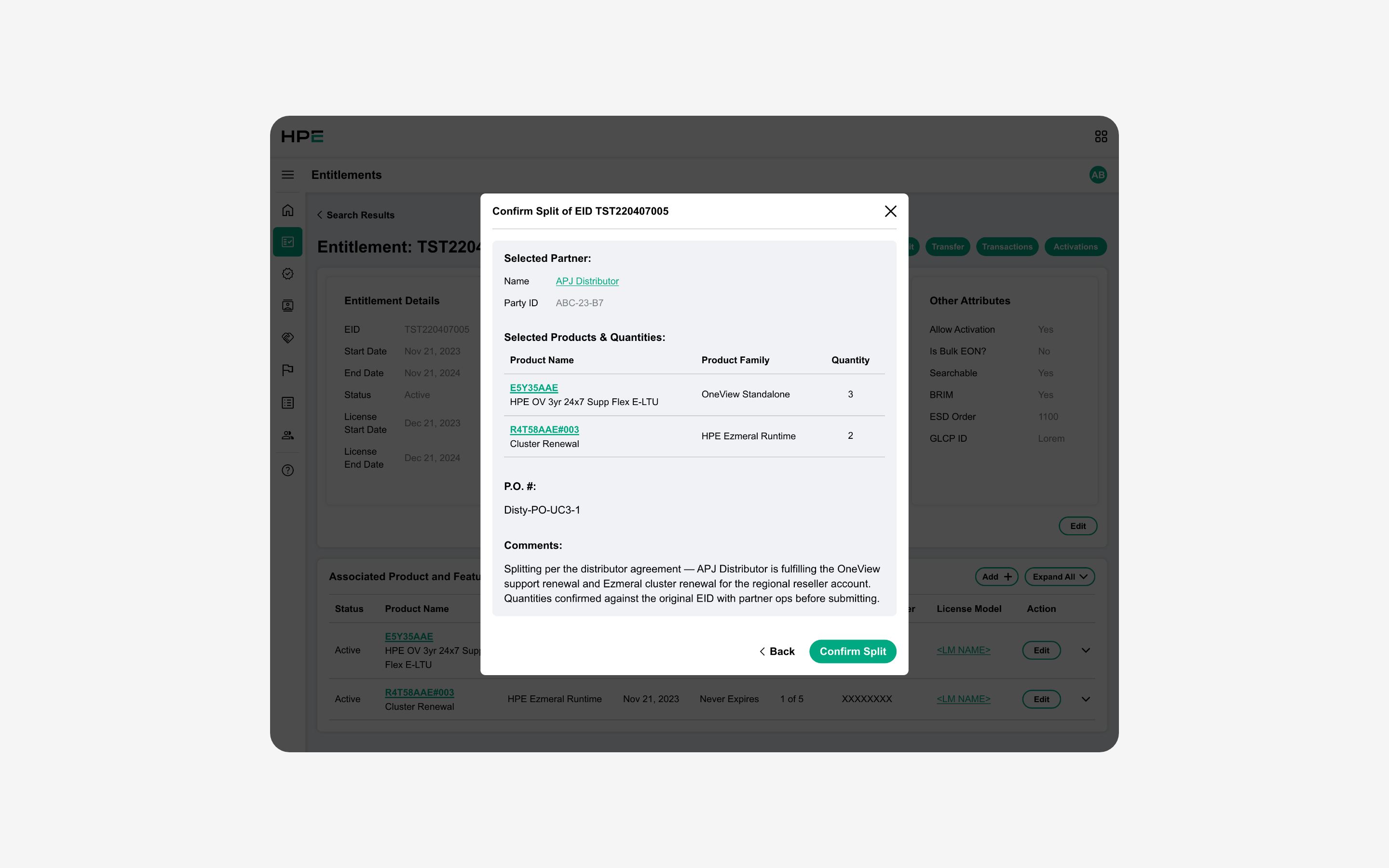
Both let a user move real licensed assets from one owner to another, and both were built around the same principle: make it hard to make a mistake, without making the flow feel bureaucratic. Every split or transfer started with a clear fork — Partner or End Customer — then converged into the same disciplined sequence: select the recipient, allocate exact quantities against a visible availability ceiling so nobody could over-allocate without seeing the limit, require a P.O. number and a case reference, and show a full review screen before anything became final.
That review-before-commit step was deliberate. Splits and transfers are the kind of action you don't want to walk into by accident. The interface didn't slow people down for its own sake — it slowed them down exactly where a mistake would have real cost, and stayed fast everywhere else.
AT SCALE
The same discipline, applied everywhere else.
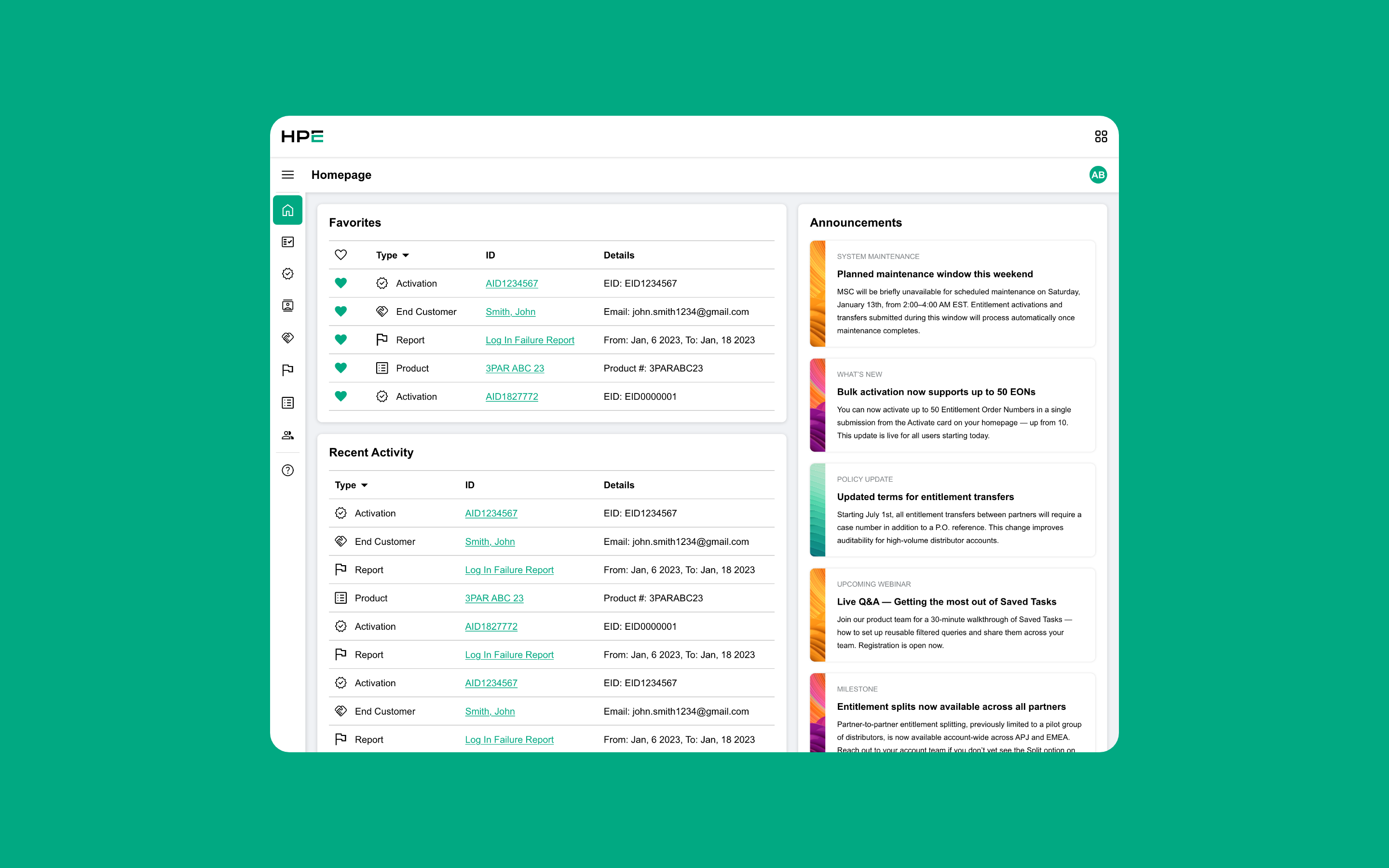
Split and Transfer got the most design attention because they carried the most risk, but the rest of the surface area needed the same discipline at lower stakes. The homepage was built around Favorites and Recent Activity, so someone managing entitlements daily could get back to a specific record without re-running a search. Activations followed the same search-to-detail pattern as Entitlements, with a small set of clear actions surfaced where the user needed them rather than buried in a menu.
The detail pages were the hardest part of that lower-stakes work. An Entitlement Details page carries order information, partner information, associated products and features, and — when you expand a line item — a second layer of attributes running dozens of fields deep. Advanced Search alone has more than twenty filterable fields. None of that density was optional; HPE customers genuinely need to cross-reference at that granularity. The job wasn't to simplify the data away. It was to organize a genuinely large amount of real information so it still read as scannable, using consistent groupings, expand/collapse patterns, and a visual hierarchy that didn't change no matter how deep a user drilled in.
OUTCOME
Still running, years later.
Bumblebee shipped and replaced Sentinel as the entitlement engine behind MSC and ESSM. It's still the platform HPE and its customers depend on today — mission-critical infrastructure in continuous production use since launch, with no need to touch the design because it simply works. Later HPE platform initiatives built on the foundation it established.
That's the outcome that matters most for infrastructure work: not a launch-week metric, but multi-year silence. Nobody notices an entitlement platform when it's working. Bumblebee has stayed invisible in exactly the way good infrastructure should.
REFLECTION
Simple on top, complicated underneath — that's the job.
What I'm proudest of is the gap between how Bumblebee feels to use and what it's actually doing. A user splitting an entitlement across partners sees a clean, guided sequence — pick a recipient, set quantities, add a reference, confirm. Underneath sits a genuinely complex licensing system, replacing a third-party platform, serving two separate products, with real contractual and financial consequences on every transaction.
That gap isn't a lucky simplification — it's the actual design work. Anyone can make a simple system feel simple. The harder, more valuable version of the job is making a deeply complicated system feel simple without hiding the stakes that make it complicated. The guardrails in Split and Transfer are exactly why the surface can stay calm. The complexity didn't disappear. It got absorbed into a small number of very deliberate decisions, placed exactly where they needed to be.