US Sports Camps (Nike Sports Camps)
Giving every camper a permanent identity, not just a receipt.
A redesign of registration, login, and checkout across ussportscamps.com — solving a duplicate-records problem created by a system that let people book and pay for camps without ever creating an account.
ROLE
UX & UI Design (contracted as Art Director)
CLIENT
US Sports Camps — official operator of Nike Sports Camps and NBC Camps
TEAM
Stellar Agency
BACKGROUND
A platform with no memory of its own users.
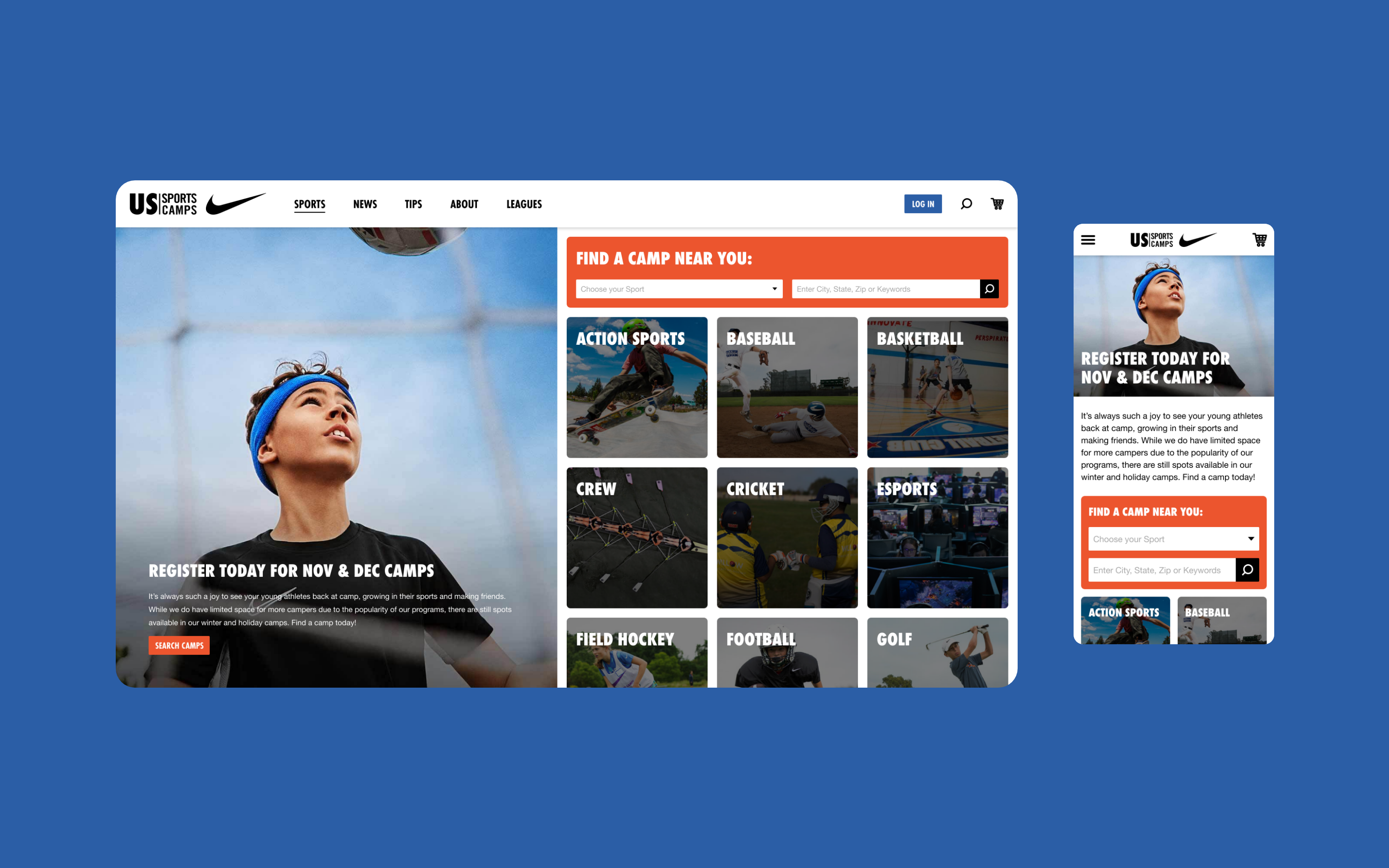
US Sports Camps runs Nike Sports Camps and NBC Camps under license — youth sports camps across dozens of sports, booked through ussportscamps.com. Stellar's engagement ran across several tracks, eventually landing on a priority initiative covering three things: a login and registration overhaul, an NBC Camps homepage redesign, and a Nike Membership login integration. I was contracted as Art Director; the work I actually did was UX/UI design, centered on login and registration.
That track existed because of a structural gap: the site let a guardian register a camper and pay for a camp without ever creating an account. Every booking was its own disconnected transaction. There was no persistent ID tying a camper or guardian across bookings — no reliable way to know that "John's mom signing up for soccer camp in June" and "John's mom signing up for basketball camp in August" were the same person.
THE CHALLENGE
Fixing identity means touching three systems at once.
The consequence of no persistent identity wasn't abstract — it was piling up as duplicate camper and guardian records inside Regware+, USSC's registration and camp-management backend. Every duplicate made reconciliation harder, reporting less trustworthy, and camper tracking messier for camp directors on the ground.
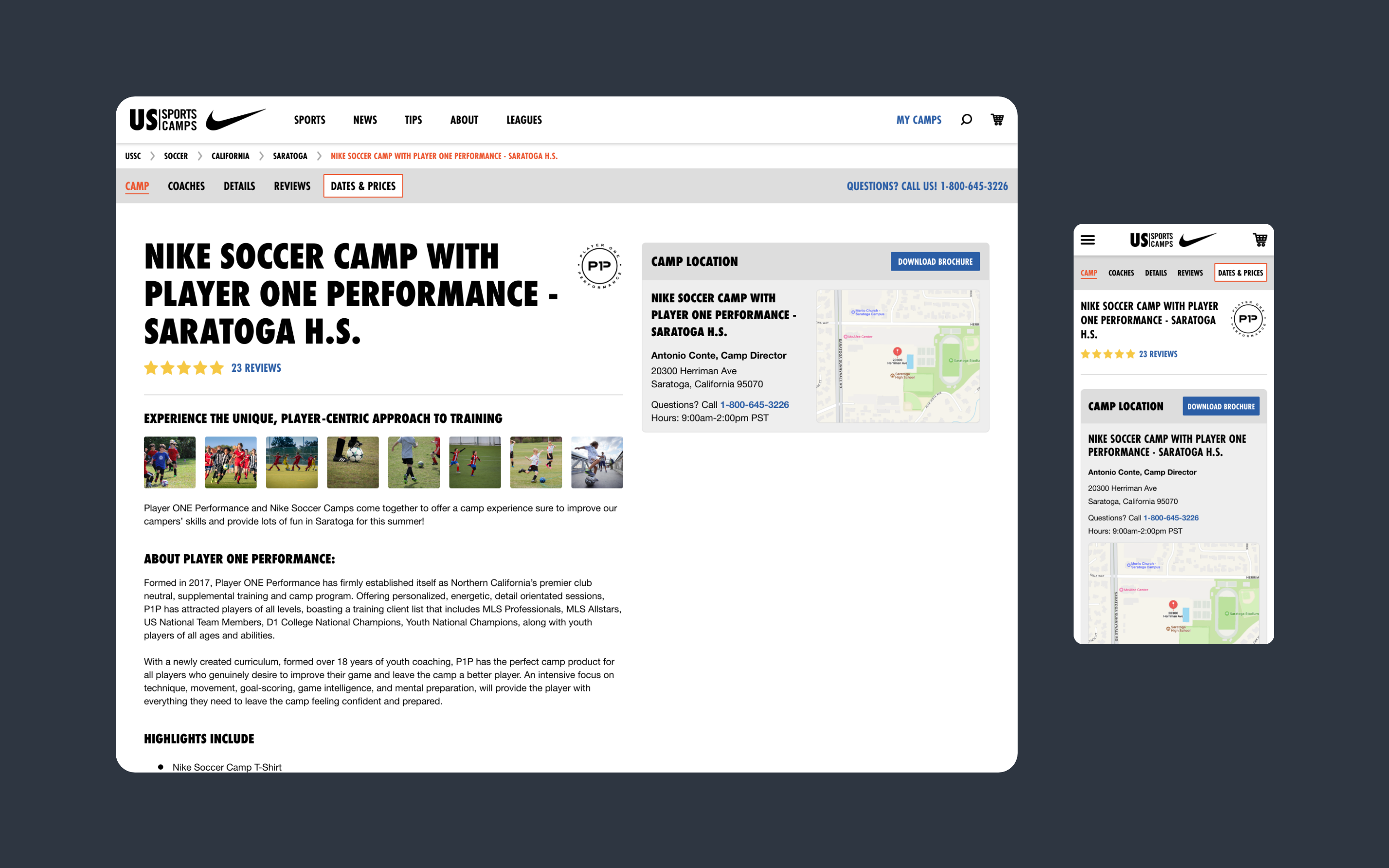
The fix wasn't a single screen. The registration and login system spanned three connected properties — the public marketing site, the secure web application handling transactions, and Regware+ on the backend — and a redesign had to hold together across all three without breaking any of them. And because USSC runs camps across many sports, each with its own registration quirks, the system wasn't one flow. It was dozens: new users, returning users, multiple-camp registrations, sport-specific restrictions, all needing the same underlying identity model.
THE WORK
One identity model, mapped across every real scenario.
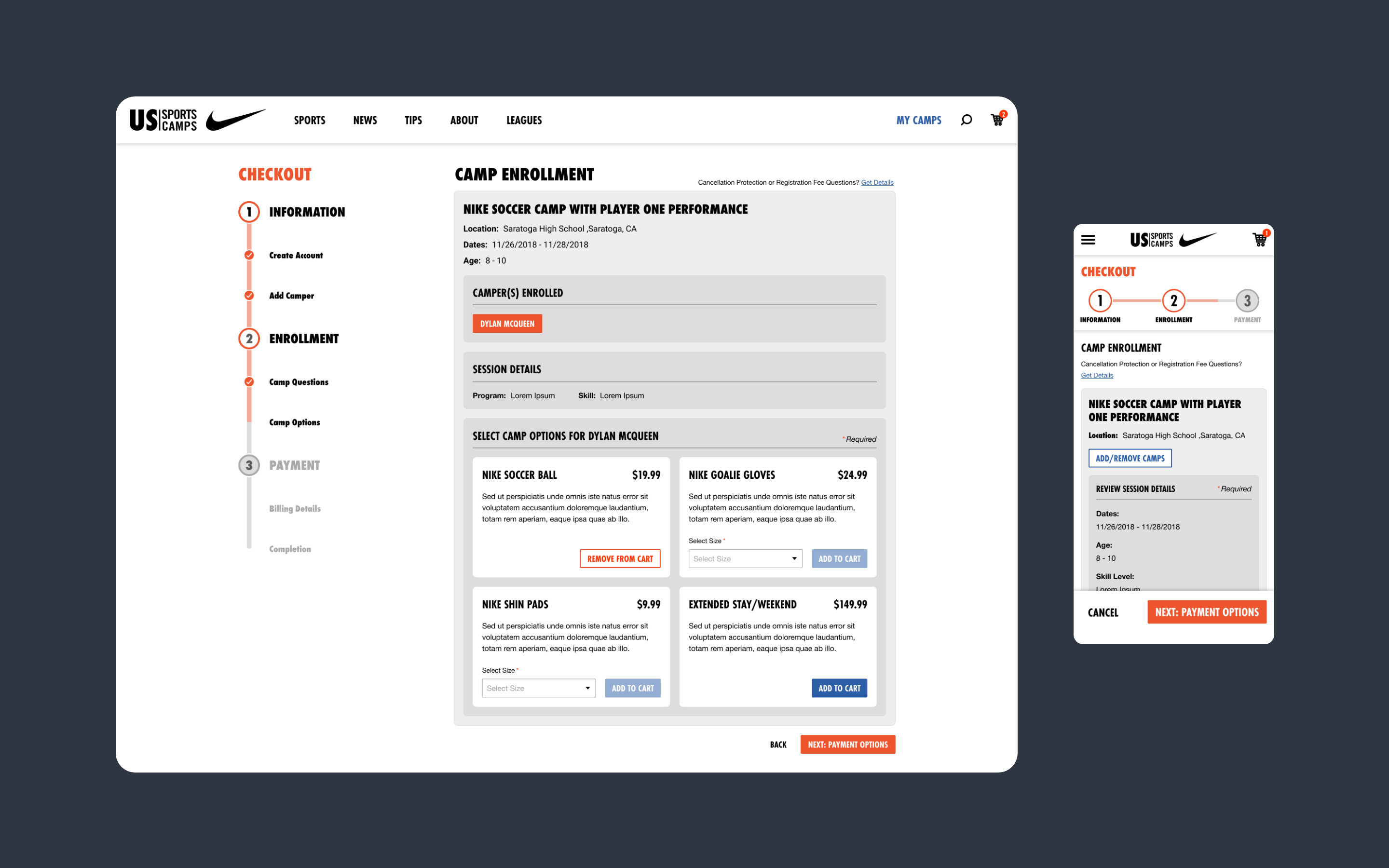
The core move was straightforward to state and hard to execute: require account creation during checkout, and assign every camper and guardian a persistent, unique ID the moment that account exists. From then on, every future booking ties back to the same identity instead of creating a new disconnected record.
Getting there meant designing for every real scenario, not just the happy path. New-user and returning-user registration, login success and failure with password reset, abandoned-cart recovery with a supporting email, a waitlist-full state, a camp-restriction state, multiple-camp registration in a single session, and add-ons like a weekend stayover — each mapped for both desktop and mobile, and repeated per sport where the registration logic differed. The full set lived across twelve separate Adobe XD files.
Smaller supporting changes rounded it out: a persistent Login link in the marketing site's global nav, so the account-first model was visible before a user ever reached checkout.
OUTCOME
Shipped, and still evolving.
The redesigned login, registration, and checkout flow launched on ussportscamps.com. The site has changed visually since, as any active platform does — but the identity model the work established (accounts tied to persistent camper and guardian IDs, created at checkout) was the durable contribution: the structural fix that made USSC's backend reporting and reconciliation trustworthy going forward.
REFLECTION
The edge cases are the actual design problem.
In a system like this, the main flow — new user registers, pays, done — is the easy 20% of the work. The real design problem lives in the branches: what happens when the cart's abandoned, when a login fails, when a camp is full, when a camper can't be added, when a family is registering for three sports at once. Skip any of those and the system doesn't actually solve the identity problem it was built for. It just handles the happy path and leaves the same duplicate-record mess everywhere else.
Designing across three connected systems also reinforced something about enterprise-adjacent UX generally: the interface is only ever the visible tip of the actual problem. The real work was making sure an identity created in one system meant the same thing in all three.